The Three-Day Window: Timing Your Wash-and-Fold Bag Around a Deptford Week

Photo: Larry D. Moore, CC BY 4.0, via Wikimedia Commons
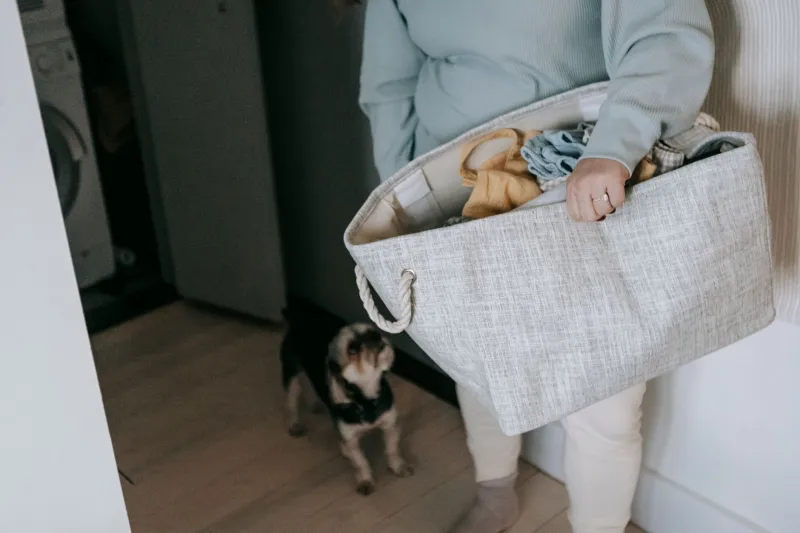
There’s a particular moment that happens in a lot of Deptford flats. You picked up your wash-and-fold on Saturday morning, carried it home past the market, dropped it by the door, and then got on with the weekend. By Tuesday it’s still there. The bag is soft, slightly warm from the hallway radiator, and you’re starting to wonder whether folded laundry has a shelf life. It does. It’s just not printed on the bag.
At the counter, we see the full range: bags collected and unpacked within an hour, and bags that come back a week later with a sheepish expression attached. Neither is a crime. But if you live above a shop, in a flat with no airing cupboard and a bathroom that never quite dries out, timing matters more than you’d think.
The clock starts when the drum stops
A common assumption is that the clock starts when you drop the bag off. It doesn’t. It starts when the wash finishes and the folding begins. Laundry coming out of a dryer or a warm press still holds a little moisture — not enough to feel wet, but enough to create a microclimate inside a closed bag. Fold it tightly, zip it up, and you’ve made a small, warm room with no ventilation. That’s fine for an hour or two. It’s less fine for three days.
This is why two people can pick up identical bags on the same afternoon and have completely different experiences. One takes theirs straight home, opens it on the kitchen table, and puts things away. The other leaves it in a hallway, on a chair, or in a wardrobe until Wednesday. Same laundry, different clock.
A rough timeline for a small Deptford flat
There’s no single expiry date, because it depends on what’s in the bag, how damp your flat is, and whether the bag is breathable or plastic. But a useful rule of thumb is the three-day window.
Day 0 to Day 1: Peak freshness. This is when towels smell like nothing at all, which is exactly what you want. Gym kits and tea towels are still in their happy place. If you can unpack within 24 hours, you’re laughing.
Day 2: Still fine for most things, provided the bag is open and the room isn’t steamy. Towels may start to feel a bit cool and clammy at the edges. This is the day to hang them over a door or a radiator rack, not fold them back into a drawer.
Day 3 to Day 4: The turn. This is when the bag stops smelling neutral and starts smelling like a bag. Gym kits, bath towels, and anything that was worn next to skin will make themselves known first. Heavier cottons and jeans are usually slower. Bedding sits somewhere in the middle.
Day 5 and beyond: The fusty zone. It’s not always obvious when you first open the bag — the smell can hide in the seams and the fold lines. But once a towel has that damp, cardboardy note, it’s not going to air itself back to fresh on a chair. It needs a wash.
The usual suspects: what turns first
Not everything in a wash-and-fold bag has the same shelf life. The fastest spoilers are the ones that hold moisture and bacteria close to the fabric: gym kits, sports socks, bath towels, bath mats, tea towels, and kitchen cloths. Synthetics can be sneaky — a polyester training top may feel dry but hold onto odour in a way cotton doesn’t.
Jumpers, jeans, and outer layers are more forgiving. They can sit a day or two longer without drama. Bedding is middle ground: fine for a couple of days, but a duvet cover left crumpled in a warm hallway will start to smell like a sleeping bag by the end of the week.
The practical takeaway is simple: unpack the fast spoilers first. If you only have two minutes when you get home, pull out the gym kit and the towels and hang them up. Leave the jeans in the bag. They won’t mind.
Warning signs your bag has crossed over
The first clue is usually not a full-room smell. It’s a smell at the seams — the inside edge of a towel, the armpit of a T-shirt, the fold line of a tea towel. Give a towel a quick sniff near the hem. If it smells like a wet coat that’s been left in a porch, that’s the turn.
The second clue is texture. Freshly folded laundry feels dry and slightly warm. Laundry that’s been sitting too long feels cool and clammy, even if it doesn’t feel wet. The third clue is the bag itself. If opening the bag releases a small sigh of stale air, that’s your laundry telling you it’s been in there too long.
And if you see a greyish tinge on white towels, or a musty note that lingers on your hands after you’ve touched the fabric, don’t try to air it out and hope for the best. A quick re-wash is usually kinder than a week of pretending.
Planning the week around drop-off and pickup
Most laundry problems in Deptford aren’t really laundry problems. They’re timetable problems. You drop off on Monday, work late Tuesday and Wednesday, and suddenly it’s Thursday night and the bag is still in the hallway. The fix isn’t a stricter personality. It’s a slot that matches your actual week.
If you know you’ve got a heavy one coming — a market Saturday, an early 7.14 train, a run of late shifts — pick a drop-off that lands your pickup on a day you’ll actually be home. A wash-and-fold bag left in a hallway is a holding pen, not storage. Treat pickup day as part of the laundry job, not an afterthought.
It also helps to have a landing spot that isn’t the floor. A hook by the door, a chair that isn’t covered in coats, a clear bit of kitchen counter. Somewhere you can open the bag, pull out the fast spoilers, and let the rest breathe for an hour before it goes into drawers. If your flat runs damp — and plenty in Deptford do — that hour matters.
A small routine that buys you a day
Open the bag as soon as you’re through the door. Not neatly, not ceremonially. Just open it. Pull out towels, gym kits, and tea towels and hang them over the back of a chair or a radiator rack. Leave the rest in the bag but fold the top down so it isn’t sealed. If you’ve got a wardrobe with a door that stays open, that’s fine too — just don’t push the bag into a dark corner and shut the door on it.
If you’re short on space, prioritise airflow over neatness. A towel draped over a door frame will dry better than a towel folded into a cupboard. A gym kit spread out on a drying rack will last longer than a gym kit balled up in a bag. You’re not aiming for a magazine laundry room. You’re aiming for a bit of moving air.
When it’s already fusty
It happens. The bag sat too long, the flat was steamy, and now the towels smell like a cellar. Don’t panic and don’t bin them. A hot wash with your usual detergent will usually sort it, and a second wash is not a failure — it’s a timetable correction. For gym kits, check the care label before you go in hot. For towels, a hot wash and a full dry is usually enough to reset the clock.
The three-day window isn’t a rule, it’s a rhythm. Some bags last longer, some turn faster, and some weeks are just busier than others. If you’re ever unsure, bring it back to the counter and ask. We’ve sniffed worse. And if you time it right, you’ll never have to meet that particular fusty surprise on a Friday morning again.